
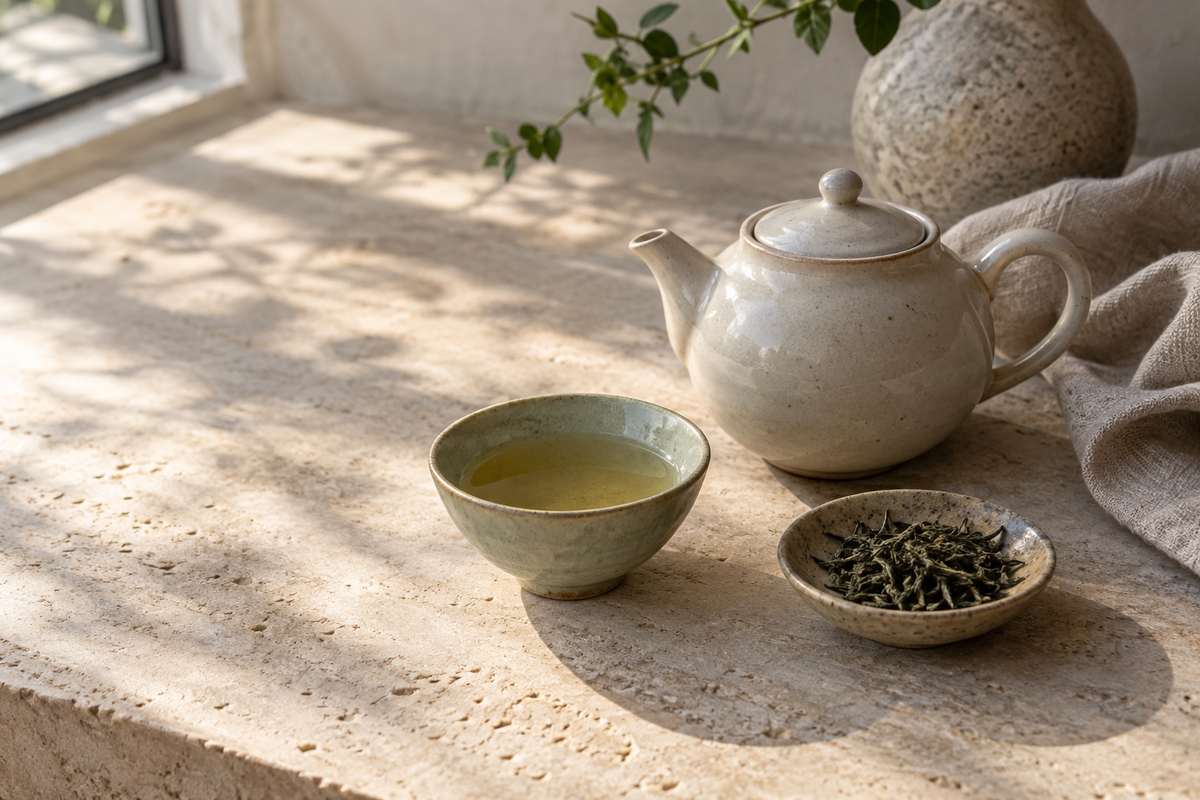
Korean tea made from the tea plant naturally contains caffeine. Decaffeinated tea should not be assumed to contain none. A Korean name, a pale infusion or a gentle flavour does not tell you how much caffeine is in your cup. The most useful information is a value documented for the exact product and preparation.
Check the ingredients before the category name
“Tea” can describe tea-leaf products and drinks made from other plants. Start with the full ingredient list. A fruit or grain blend may also include green tea, so a fruit picture or an infusion-style name is not evidence of zero caffeine.
When a product has a caffeine statement, read what it refers to: the dry product, a specified serving or a prepared volume. Those quantities cannot be compared without the preparation details.
Why a single number can mislead
The amount in a drink depends on the product, the amount used and the way it is prepared. A general reference figure for a cup of tea is not a laboratory result for a particular pouch. We do not turn a category average into a precise caffeine declaration for every product.
Powdered drinks deserve a separate check. Find out whether the product is tea powder alone or a prepared mix, and what portion the manufacturer specifies. Do not assume two green powders have the same composition.
Decaffeinated does not promise zero
Decaffeination and a caffeine-free statement are different things. If avoiding caffeine is essential to your choice, look for product-specific documentation rather than assuming that the word “decaffeinated” guarantees none remains.
How to compare two products
- Read the complete ingredient list.
- Find the manufacturer's caffeine information, if provided.
- Check the unit: per gram, per portion or per volume of drink.
- Use the stated portion and preparation when interpreting that value.
- Treat missing information as unknown, not zero.
General safety information is a different question
EFSA assesses caffeine intake from all dietary sources, including supplements. Its population-level assessment is not a caffeine measurement of a tea and is not a personalised target to reach. Sensitivity and circumstances differ; if you have been advised to limit caffeine, follow that advice and ask your healthcare professional about uncertain products.
Our approach
We describe what the maker has documented and identify gaps. We do not infer a health benefit from a tasting note, a tea grade or a manufacturing story. Nutrition and health claims require their own assessment under the applicable rules; a scientific study is not, by itself, permission to make a claim on a product page.
Explore our caffeine-free selection guide or read how to choose a first Korean tea. A collection guide is a starting point; check the information for the specific product before ordering.
Sources
- Chin et al.: caffeine content of brewed teas
- EFSA: caffeine
- Health Canada: caffeine in foods
- European Commission: nutrition and health claims
Seoul Rituals editorial team. Updated 13 October 2026.