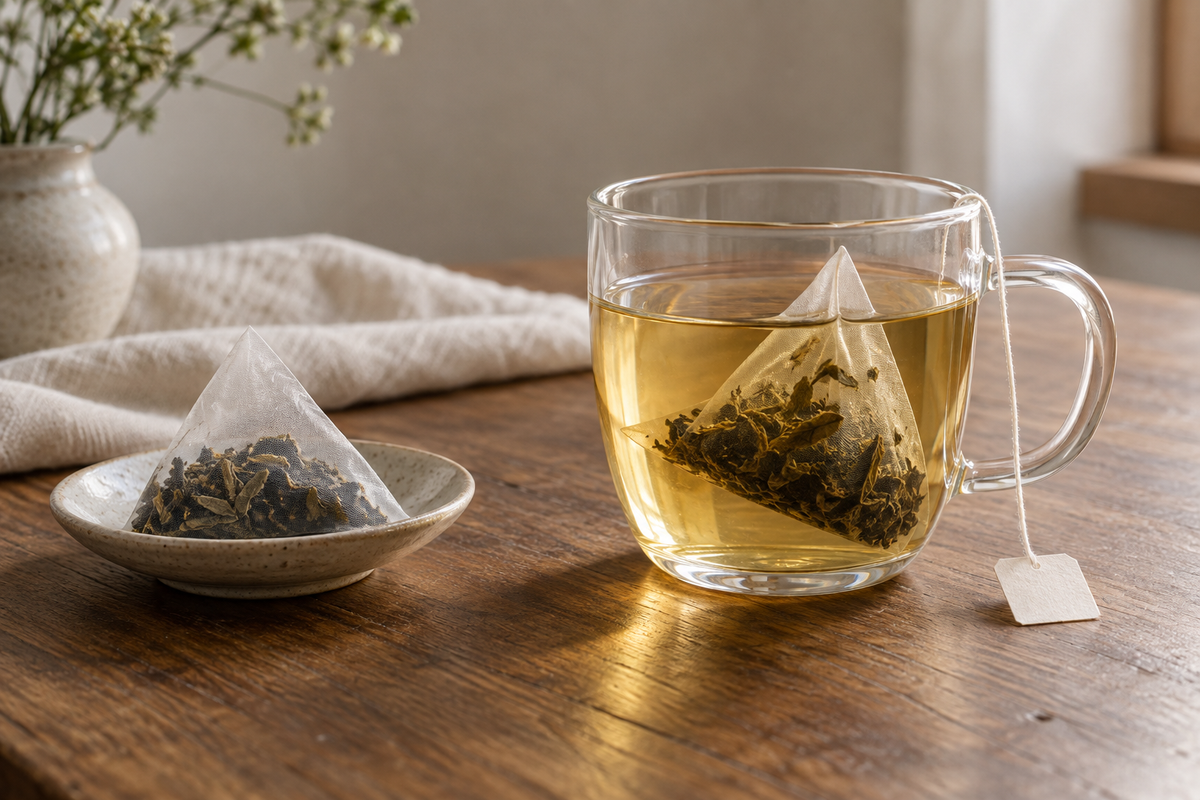
Choose a format by the preparation you want to repeat. Loose leaf gives you control over the portion, tea bags make portioning simpler, and powder requires you to check whether you are buying tea itself or a prepared drink mix. None is automatically the best choice for every person or every occasion.
First, picture an ordinary day
Think about where you will make the drink, the equipment you already have and how much you want to measure. A spacious kitchen and a desk with one mug are different situations. The format that makes sense is the one whose preparation you can carry out comfortably.
You can also keep more than one format. There is no need to make a permanent choice between a measured pot at home and a bag at work.
Loose leaf: control over the portion
Loose leaf suits a routine in which measuring is part of the pleasure. You need a pot or infuser that lets you separate the leaves from the drink. Look for the maker’s instructions for amount, water volume, temperature and infusion time.
Compare net weight rather than pouch dimensions. If the recommended portion is documented, it can help you estimate how many preparations the pack provides. Do not assume every tea uses the same portion or guarantees the same number of repeat infusions.
As one specific example, OSULLOC's current Sejak 40 g page recommends 70°C water and 1.5 minutes. That is a product instruction, not a universal loose-leaf recipe.
Tea bags and pyramids: a portion already measured
A bag removes one measuring step. You still need to check how much water it is designed for and when to remove it. Compare the number of bags, the weight per bag where stated, and the full ingredient list.
The shape of a bag is not enough to prove leaf quality. Nor does a transparent-looking bag tell you its material. OSULLOC identifies PLA for its current Sejak 20-bag reference; that statement should not be transferred to another bag or turned into an unsupported home-composting claim.
Powder: read the ingredient list first
“Powder” describes a physical format, not a complete recipe. A pack can contain tea powder alone or several ingredients formulated into a drink. A green colour, a whisk on the package or a stick format cannot settle that distinction.
Check how the maker asks you to mix it and the intended quantity of liquid. Do not assume a pure tea powder is an instant soluble mix, or that every powder is designed to be prepared like matcha. Compare the exact composition before deciding whether it fits the drink you want.
Compare the effort as well as the price
- Portioning: measured by you, supplied in a bag, or specified for a powder?
- Equipment: a cup, an infuser, a pot or a mixing tool?
- Instructions: complete enough to make a repeatable first drink?
- Contents: plain tea, a blend or a prepared mix?
- Quantity: grams and units across the whole pack?
- Afterwards: how will you clean the equipment and reseal the product?
Make a small first choice
Start with the format you can use now. Choose the pack size you expect to finish comfortably and follow its storage directions. If you later want to compare another format, keep the tea type or flavour preference as similar as possible; otherwise you may be comparing two different drinks as well as two preparation methods.
Our pack-size comparison article explains unit prices with a worked example. The collections below help you explore the formats without assuming that one is inherently superior.
References
OSULLOC Sejak 40 g; OSULLOC Sejak 20 bags. Product specifications relate to the references shown by the manufacturer and should be checked against the current pack.
By Seoul Rituals editorial team. Updated 13 September 2026.